Why Is Communism Is Cool Again
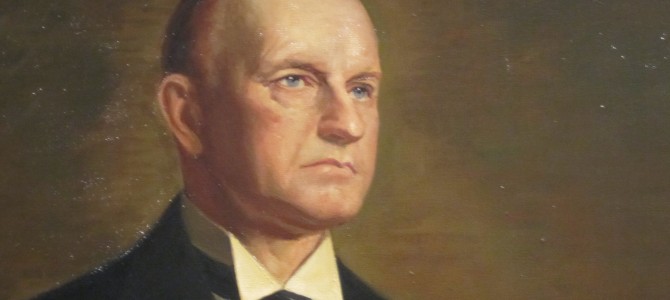
On Thursday evening, October 28, 1920, vice presidential candidate Silent Cal Coolidge invaded Manhattan.
Commencing from Wall Street, his plan was to process steadily uptown, existence joined by equally many supporters as he might, to finally achieve Carnegie Hall, there to address whatever Republican true-blue he might concenter within the urban center limits.
The New York Times, for some reason, lacked religion that much might come up from his plan.
But every bit Coolidge advanced ever northward, a full seventy-five g enthusiastic marchers joined with him, representing whatever number of the city's trades and professions. They advanced through Greenwich Village's Washington Square and up Fifth Avenue. A segment formed a giant electric American flag. And when the candidate reached Carnegie Hall, he found it full to overflowing. Then much so that a swain named Whitaker Chambers (not yet a Communist nor a spy nor a hero) perched himself upon a fire escape to be inspired by his words.
Ah, that was some night.
Information technology has been tough sledding for Cal's reputations for quite some decades at present. The historians have scoffed. The economists have mocked. His ungrateful conservative heirs accept largely ignored his impressive tape of cut spending and taxes and jump starting the economy.
But, suddenly that has inverse—and wildly so. Commentators from Grover Norquist ("Nosotros're looking for some other Coolidge") to Jonah Goldberg ("Coolidge was one of the greatest presidents of the 20th century and is certainly the virtually underrated") to George Will ("Calvin Coolidge, the terminal president with whom I fully agreed . . .") to Mark Steyn ("If you're similar me and your idea of a conservative president is Calvin Coolidge . . .") to Glenn Beck (Coolidge "might exist my favorite President so far. I like the guy") have sung his praises.
With such a current of air at their back, modern Coolidgites accept taken heart and invaded Manhattan'southward enemy territory nonetheless again: occupying neither Wall Street nor Carnegie Hall but Midtown'south swank Four Seasons Restaurant, jamming it to honor Coolidge every bit well as the organization dedicated to his memory, the Calvin Coolidge Memorial Foundation.
The Foundation has been around for a while, fifty-some years to exist exact, but iii months ago it had the profound expert sense to designate as its president Amity Shlaes, author of the recent all-time-selling Coolidge biography. In an era of fiscal profligacy and resultant stagflation, Ms. Shlaes' Coolidge has initiated a give-and-take not only of what was washed, simply how information technology was done, and what will have to be done again. When The New Yorker devotes four,000 words to Calvin Coolidge (as it did in reviewing Shlaes' magnum opus), you lot know something'due south upward.
Her volume has been a game-changer, stirring upward debate on Coolidge and finally providing embattled conservatives with another hero besides the estimable Ronald Reagan—in fact, a more successful 1, at to the lowest degree, on monetary matters. Where Reagan ran a arrears, Coolidge cut taxes and spending, accumulated surpluses and sharply slashed the national debt. And where Reagan cashiered hitting air traffic controllers, Coolidge dealt firmly with striking Boston police force. "At that place is no right to strike against the public prophylactic," said Silent Cal, "by anybody, anywhere, any time."
The numbers spoke for themselves—and even so do. His accomplishments included:
- Reducing the national debt from $22.3 billion in 1923 to $16.ix billion in 1929.
- Reducing federal expenditures of $v.1 billion in 1921 to $3.3 billion in 1929.
- Cutting taxes four out of his vi years as president.
- Reducing the highest effective tax charge per unit from fifty percent (1922) to 25 percent simply increasing revenue from that tax bracket from $77 million to $230 million.
- Slashing the tax burden on incomes under $x,000 from $130 meg in 1923 to nether $20 meg in 1929; past 1927, 98 percent of the population paid no income tax.
"Information technology is only a tiny exaggeration," noted historian Thomas B. Silver, ''to say that Coolidge and [Treasury Secretarial assistant Andrew] Mellon completely removed the brunt of federal income taxation from the backs of poor and working people between the time Coolidge entered the presidency and the time he left."
And such numbers worked wonders beyond the balance sheet, helping to trigger a widely-based economic nail:
- Unemployment averaged three.3 percentage from 1922 to 1929.
- The Gross National Production increased annually by 7 percent from 1924 to 1929.
- Per capita income grew 30 percent from 1922 to 1928.
- Real earnings for employed wage earners increased 22 percentage from 1922 to 1928.
- Industrial production increased seventy per centum from 1922 to 1928.
- The average workweek decreased four percent from 1922 to 1928.
- Automobile ownership expanded three fold in the decade.
Only back to the nowadays—and to the Pool Room (which really has nil to do, I must say, with billiards at all) of the 4 Seasons. What transpired provided powerful evidence that the study of Coolidge was no longer to be restricted to the nether regions of academia (or central Vermont). The articulation was packed. If the 4 Seasons had a fire escape, people would have been upon it. And quality certainly augmented quantity. Seen mingling among the oversupply were Steve Forbes, CNBC's Larry Kudlow, star Autonomous pollster Doug Schoen, syndicated columnist Cal Thomas, Reagan Upkeep Director David Stockman, erstwhile Vermont Governor Jim Douglas, Wall Street Periodical columnist Mary O'Grady, Manhattan Institute President Larry Mone, Hudson Plant Beau (and former American Enterprise Institute president) Christopher DeMuth, authors George H. Nash (the nation'southward premier Herbert Hoover scholar), Charles C. Johnson (another Coolidge biographer) and Dr. James Otteson (a Templeton Enterprise Prize winner), John Batchelor Testify producer Lee Bricklayer, the Bush Institute's Machir Stull—and The Federalist's ain Ben Domenech.
Awards were properly presented, and counted amongst the ranks of those judging the contest for the CCMF'due south newly-minted "Coolidge Award" for journalists (won past the Wall Street Journal's brilliant Holman Jenkins) were historian Richard Norton Smith, quondam Indiana Governor Mitch Daniels, and Bloomberg Goggle box's Trish Regan.
The biggest proper name (and at 6'7", the biggest person period) gracing the evening's program was a surprising one: legendary quondam Federal Reserve Chairman Paul Volcker. Volcker, however, already stood on record in praise of Coolidge, telling Shlaes very recently, "What we understood was that Coolidge was kind of a practice-zip president. He took over for Harding, he was an honest guy, he was kind of open and frugal, but that was it. But in fact there'due south and then much to acquire from Coolidge. Any president is going to face a lot of bug and Coolidge faced upward to them. He produced, after Harding, honest authorities. He contributed to some degree of trust in government." At the Iv Seasons, the nonetheless feisty (at 86) Volcker predicted, "The day will come . . . they volition have to permit the normal market forces to operate in such a style that interest rates may resume more than normal levels."
The Thirtieth President's message, Coolidge Prize winner Holman Jenkins afterward commented, allows us to "better empathize the forces bearing on the president and Congress almost a century later. I am honored to accept this Prize . . . maybe information technology volition help u.s. to remember what Coolidge stood for at a time when we need him almost."
Award-winning historian David Pietrusza has produced three books on Calvin Coolidge: Silent Cal's Almanack: The Homespun Wit and Wisdom of Vermont's Calvin Coolidge, Calvin Coolidge: A Documentary Biography, and Calvin Coolidge on The Founders: Reflections on the American Revolution & the Founding Fathers.

Source: https://thefederalist.com/2013/11/18/coolidge-cool/
0 Response to "Why Is Communism Is Cool Again"
Post a Comment