How Common Is the Art of Georgia O Keefe?
| Georgia O'Keeffe | |
|---|---|
 O'Keeffe in 1918, photo by Alfred Stieglitz | |
| Born | Georgia Totto O'Keeffe (1887-eleven-15)November 15, 1887 Sun Prairie, Wisconsin, U.S. |
| Died | March half-dozen, 1986(1986-03-06) (aged 98) Santa Fe, New Mexico, U.Due south. |
| Teaching | Schoolhouse of the Art Establish of Chicago Columbia College Teachers Higher, Columbia University University of Virginia Art Students League of New York |
| Known for | Painting |
| Motility | American modernism, Precisionism |
| Spouse(s) | Alfred Stieglitz (m. 1924; died ) |
| Family unit | Ida O'Keeffe (sister) |
| Awards | National Medal of Arts (1985) Presidential Medal of Freedom (1977) Edward MacDowell Medal (1972) |
Georgia Totto O'Keeffe (Nov xv, 1887 – March vi, 1986) was an American modernist artist. She was known for her paintings of enlarged flowers, New York skyscrapers, and New Mexico landscapes. O'Keeffe has been chosen the "Mother of American modernism".[ane] [2]
In 1905, O'Keeffe began fine art training at the School of the Art Plant of Chicago[three] and and so the Art Students League of New York. In 1908, unable to fund further education, she worked for 2 years as a commercial illustrator and then taught in Virginia, Texas, and South Carolina between 1911 and 1918. She studied art in the summers betwixt 1912 and 1914 and was introduced to the principles and philosophies of Arthur Wesley Dow, who created works of fine art based upon personal manner, design, and interpretation of subjects, rather than trying to copy or represent them. This caused a major change in the manner she felt about and approached fine art, as seen in the showtime stages of her watercolors from her studies at the Academy of Virginia and more than dramatically in the charcoal drawings that she produced in 1915 that led to total abstraction. Alfred Stieglitz, an art dealer and photographer, held an exhibit of her works in 1917.[four] Over the next couple of years, she taught and connected her studies at the Teachers College, Columbia University.
She moved to New York in 1918 at Stieglitz's request and began working seriously as an artist. They developed a professional person and personal relationship that led to their union in 1924. O'Keeffe created many forms of abstract fine art, including shut-ups of flowers, such as the Blood-red Canna paintings, that many found to stand for vulvas,[five] though O'Keeffe consistently denied that intention.[six] The imputation of the depiction of women's sexuality was also fueled by explicit and sensuous photographs of O'Keeffe that Stieglitz had taken and exhibited.
O'Keeffe and Stieglitz lived together in New York until 1929, when O'Keeffe began spending part of the year in the Southwest, which served as inspiration for her paintings of New United mexican states landscapes and images of brute skulls, such as Moo-cow's Skull: Red, White, and Blue and Ram's Head White Hollyhock and Fiddling Hills. After Stieglitz's death, she lived in New United mexican states at Georgia O'Keeffe Dwelling house and Studio in Abiquiú until the last years of her life, when she lived in Santa Fe. In 2014, O'Keeffe's 1932 painting Jimson Weed/White Blossom No. 1 sold for $44,405,000, more than three times the previous globe auction tape for any female artist.[vii] After her death, the Georgia O'Keeffe Museum was established in Santa Fe.
Early on life [edit]
Georgia O'Keeffe was born on November 15, 1887,[2] [8] in a farmhouse in the town of Sun Prairie, Wisconsin.[9] [10] Her parents, Francis Calyxtus O'Keeffe and Ida (Totto) O'Keeffe, were dairy farmers. Her father was of Irish descent. Her maternal grandad, George Victor Totto, for whom O'Keeffe was named, was a Hungarian count who came to the U.s. in 1848.[2] [11]
O'Keeffe was the second of seven children.[2] She attended Town Hall School in Sun Prairie.[12] Past historic period 10, she had decided to become an artist,[13] and with her sisters, Ida and Anita,[14] she received fine art educational activity from local watercolorist Sara Isle of man. O'Keeffe attended loftier schoolhouse at Sacred Heart Academy in Madison, Wisconsin, equally a boarder between 1901 and 1902. In late 1902, the O'Keeffes moved from Wisconsin to the shut-knit neighborhood of Peacock Loma in Williamsburg, Virginia, where O'Keeffe'southward father started a business organisation making rusticated cast concrete cake in anticipation of a demand for the block in the Peninsula building merchandise, only the demand never materialized.[fifteen] O'Keeffe stayed in Wisconsin with her aunt attending Madison Fundamental High School[16] until joining her family unit in Virginia in 1903. She completed loftier school as a boarder at Chatham Episcopal Institute in Virginia (at present Chatham Hall), graduating in 1905. At Chatham, she was a member of Kappa Delta sorority.[two] [12]
O'Keeffe taught and headed the art department at West Texas Land Normal College, watching over her youngest sibling, Claudia, at her mother's request.[17] In 1917, she visited her brother, Alexis, at a armed forces camp in Texas before he shipped out for Europe during World War I. While at that place, she created the painting The Flag,[18] which expressed her anxiety and depression near the war.[19]
Career [edit]
Education and early on career [edit]
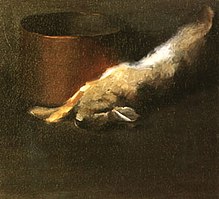
Georgia O'Keeffe, Untitled, 1908, Fine art Students League of New York collection
From 1905 to 1906, O'Keeffe was enrolled at the School of the Art Constitute of Chicago, where she studied with John Vanderpoel and ranked at the pinnacle of her grade.[2] [thirteen] As a result of contracting typhoid fever, she had to take a year off from her education.[ii] In 1907, she attended the Art Students League in New York Metropolis, where she studied nether William Merritt Hunt, Kenyon Cox, and F. Luis Mora.[2] In 1908, she won the League's William Merritt Chase even so-life prize for her oil painting Dead Rabbit with Copper Pot. Her prize was a scholarship to nourish the League'south outdoor summer schoolhouse in Lake George, New York.[2] While in the New York City, O'Keeffe visited galleries, such as 291, co-owned by her future hubby, photographer Alfred Stieglitz. The gallery promoted the work of avant-garde artists and photographers from the United States and Europe.[2]
In 1908, O'Keeffe discovered that she would not exist able to finance her studies. Her father had gone bankrupt and her mother was seriously ill with tuberculosis.[2] She was not interested in a career as a painter based on the mimetic tradition that had formed the basis of her art training.[13] She took a chore in Chicago as a commercial artist and worked at that place until 1910, when she returned to Virginia to recuperate from the measles[xx] and subsequently moved with her family to Charlottesville, Virginia.[2] She did not paint for four years and said that the smell of turpentine fabricated her ill.[13] She began teaching art in 1911. 1 of her positions was at her former school, Chatham Episcopal Institute, in Virginia.[2] [21]
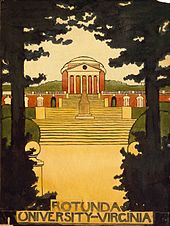
She took a summertime fine art course in 1912 at the University of Virginia from Alon Bement, who was a Columbia University Teachers College faculty member. Under Bement, she learned of the innovative ideas of Arthur Wesley Dow, Bement's colleague. Dow's arroyo was influenced by principles of design and limerick in Japanese fine art. She began to experiment with abstract compositions and develop a personal manner that veered abroad from realism.[two] [xiii] From 1912 to 1914, she taught fine art in the public schools in Amarillo in the Texas Panhandle, and was a instruction banana to Bement during the summers.[2] She took classes at the University of Virginia for two more summers.[22] She likewise took a form in the bound of 1914 at Teachers Higher of Columbia University with Dow, who further influenced her thinking near the process of making art.[23] Her studies at the University of Virginia, based upon Dow's principles, were pivotal in O'Keeffe's development as an artist. Through her exploration and growth as an artist, she helped to establish the American modernism motility.

She taught at Columbia College in Columbia, South Carolina in belatedly 1915, where she completed a serial of highly innovative charcoal abstractions[thirteen] based on her personal sensations.[21] In early on 1916, O'Keeffe was in New York at Teachers College, Columbia University. She mailed the charcoal drawings to a friend and sometime classmate at Teachers College, Anita Pollitzer, who took them to Alfred Stieglitz at his 291 gallery early in 1916.[24] Stieglitz found them to be the "purest, finest, sincerest things that had entered 291 in a long while", and said that he would like to evidence them. In April that year, Stieglitz exhibited ten of her drawings at 291.[ii] [13]

Afterward farther course work at Columbia in early 1916 and summer teaching for Bement,[2] she became the chair of the fine art department at W Texas State Normal Higher, in Canyon, Texas beginning in the fall of 1916.[25] She began a series of watercolor paintings based upon the scenery and expansive views during her walks,[21] [26] including vibrant paintings of Palo Duro Canyon.[27] O'Keeffe, who enjoyed sunrises and sunsets, developed a fondness for intense and nocturnal colors. Building upon a practice she began in South Carolina, O'Keeffe painted to express her most private sensations and feelings. Rather than sketching out a blueprint before painting, she freely created designs. O'Keeffe continued to experiment until she believed she truly captured her feelings in the watercolor, Light Coming on the Plains No. I (1917).[21] She "captured a monumental landscape in this uncomplicated configuration, fusing blue and dark-green pigments in almost indistinct tonal graduations that simulate the pulsating event of light on the horizon of the Texas Panhandle," according to author Sharyn Rohlfsen Udall.[21] [26] Afterwards her human relationship with Alfred Stieglitz started, her watercolor paintings ended quickly. Stieglitz heavily encouraged her to quit because the use of watercolor was associated with apprentice women artists.[28]
New York [edit]
Stieglitz, 24 years older than O'Keeffe,[28] provided financial back up and arranged for a residence and place for her to pigment in New York in 1918. They developed a close personal relationship while he promoted her work.[2] She came to know the many early American modernists who were office of Stieglitz's circle of artists, including painters Charles Demuth, Arthur Dove, Marsden Hartley, John Marin, and photographers Paul Strand and Edward Steichen. Strand'due south photography, too equally that of Stieglitz and his many photographer friends, inspired O'Keeffe's work. Also around this time, O'Keeffe became sick during the 1918 flu pandemic.[11]

O'Keeffe began creating simplified images of natural things, such every bit leaves, flowers, and rocks.[29] Inspired past Precisionism, The Green Apple, completed in 1922, depicts her notion of simple, meaningful life.[30] O'Keeffe said that yr, "it is just by selection, past emptying, and by accent that we get at the real significant of things."[30] Blue and Light-green Music expresses O'Keeffe's feelings about music through visual art, using bold and subtle colors.[31]
Also in 1922, announcer Paul Rosenfeld commented "[the] Essence of very womanhood permeates her pictures", citing her apply of colour and shapes equally metaphors for the female body.[32] This same article likewise describes her paintings in a sexual manner.[32]
O'Keeffe, most famous for her depiction of flowers, fabricated about 200 flower paintings,[33] which by the mid-1920s were large-scale depictions of flowers, as if seen through a magnifying lens, such as Oriental Poppies [34] [35] and several Red Canna paintings.[36] She painted her showtime big-calibration flower painting, Petunia, No. two, in 1924 and it was first exhibited in 1925.[2] Making magnified depictions of objects created a sense of awe and emotional intensity.[29] On November 20, 2014, O'Keeffe'southward Jimson Weed/White Flower No 1 (1932) sold for $44,405,000 in 2014 at auction to Walmart heiress Alice Walton, more than than 3 times the previous world auction record for any female artist.[37] [38]
Art historian Linda Nochlin interpreted Blackness Iris Three (1926) equally a morphological metaphor for a vulva, but O'Keeffe rejected that estimation, claiming they were just pictures of flowers.[39] [40]
After having moved into a 30th floor apartment in the Shelton Hotel in 1925,[41] O'Keeffe began a serial of paintings of the city skyscrapers and skyline.[42] 1 of her most notable works, which demonstrates her skill at depicting the buildings in the Precisionist style, is the Radiator Building – Nighttime, New York.[43] [44] Other examples are New York Street with Moon (1925),[45] The Shelton with Sunspots, N.Y. (1926),[46] and Metropolis Night (1926).[2] She made a cityscape, East River from the Thirtieth Story of the Shelton Hotel in 1928, a painting of her view of the Due east River and fume-emitting factories in Queens.[42] The next year she fabricated her final New York City skyline and skyscraper paintings and traveled to New United mexican states, which became a source of inspiration for her work.[43]
In 1924, Stieglitz arranged a simultaneous exhibit of O'Keeffe's works of art and his photographs at Anderson Galleries and arranged for other major exhibits.[47] The Brooklyn Museum held a retrospective of her piece of work in 1927.[24] In 1928, Stieglitz announced that 6 of her calla lily paintings sold to an anonymous buyer in France for US$25,000, but there is no evidence that this transaction occurred the way Stieglitz reported.[ citation needed ] As a consequence of the press attention, O'Keeffe's paintings sold at a higher price from that indicate onward.[48] [49] By the late 1920s she was noted for her work depicting American subjects, peculiarly for the paintings of New York urban center skyscrapers and close-up paintings of flowers.[47]
Taos [edit]
O'Keeffe traveled to New Mexico by 1929 with her friend Rebecca Strand and stayed in Taos with Mabel Dodge Luhan, who provided the women with studios.[l] From her room she had a clear view of the Taos Mountains equally well as the morada (meetinghouse) of the Hermanos de la Fraternidad Piadosa de Nuestro Padre Jesús Nazareno aka the Penitentes.[51] O'Keeffe went on many pack trips, exploring the rugged mountains and deserts of the region that summer and later visited the nearby D. H. Lawrence Ranch,[50] where she completed her now famous oil painting, The Lawrence Tree, currently owned by the Wadsworth Archives in Hartford, Connecticut.[52] O'Keeffe visited and painted the nearby historical San Francisco de Asis Mission Church at Ranchos de Taos. She made several paintings of the church, as had many artists, and her painting of a fragment of information technology silhouetted confronting the sky captured it from a unique perspective.[53] [54]
New United mexican states and New York [edit]
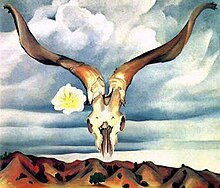
Georgia O'Keeffe, Ram'southward Head White Hollyhock and Little Hills, 1935, The Brooklyn Museum
O'Keeffe and so spent role of nearly every yr working in New Mexico. She nerveless rocks and bones from the desert floor and made them and the distinctive architectural and landscape forms of the expanse subjects in her work.[29] Known as a loner, O'Keeffe often explored the land she loved in her Ford Model A, which she purchased and learned to drive in 1929. She often talked about her fondness for Ghost Ranch and Northern New Mexico, as in 1943, when she explained, "Such a beautiful, untouched lonely feeling place, such a fine part of what I call the 'Faraway'. Information technology is a identify I take painted before ... even now I must practise it once again."[54]
O'Keeffe did not work from late 1932 until most the mid-1930s [54] as she endured various nervous breakdowns and was admitted to a psychiatric hospital.[28] These nervous breakdowns were the result of O'Keeffe learning of her husband's affair.[28] She was a pop artist, receiving commissions while her works were existence exhibited in New York and other places.[55] In 1936, she completed what would become one of her best-known paintings, Summer Days. It depicts a desert scene with a deer skull with vibrant wildflowers. Resembling Ram's Caput with Hollyhock, it depicted the skull floating above the horizon.[55] [56]
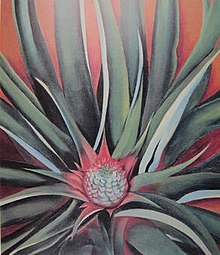
Pineapple Bud, 1939, oil on canvas
In 1938, the ad agency Due north. W. Ayer & Son approached O'Keeffe about creating 2 paintings for the Hawaiian Pineapple Company (at present Dole Nutrient Company) to use in advertizement.[57] [58] [59] Other artists who produced paintings of Hawaii for the Hawaiian Pineapple Visitor's advertizement include Lloyd Sexton, Jr., Millard Sheets, Yasuo Kuniyoshi, Isamu Noguchi, and Miguel Covarrubias.[60] The offering came at a disquisitional time in O'Keeffe's life: she was 51, and her career seemed to be stalling (critics were calling her focus on New United mexican states limited, and branding her desert images "a kind of mass production").[61] She arrived in Honolulu February 8, 1939, aboard the SS Lurline and spent nine weeks in Oahu, Maui, Kauai, and the island of Hawaii. By far the almost productive and vivid period was on Maui, where she was given complete freedom to explore and paint.[61] [62] She painted flowers, landscapes, and traditional Hawaiian fishhooks. Back in New York, O'Keeffe completed a serial of twenty sensual, verdant paintings. Withal, she did not paint the requested pineapple until the Hawaiian Pineapple Company sent a plant to her New York studio.[63]
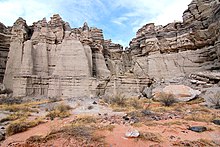
O'Keeffe's "White Place", the Plaza Blanca cliffs and badlands near Abiquiú
During the 1940s, O'Keeffe had two one-woman retrospectives, the showtime at the Art Institute of Chicago (1943).[29] Her second was in 1946, when she was the first woman artist to take a retrospective at the Museum of Modern Art (MoMA) in Manhattan.[33] Whitney Museum of American Art began an effort to create the kickoff catalogue of her work in the mid-1940s.[55]
In the 1940s, O'Keeffe made an extensive series of paintings of what is chosen the "Black Place", about 150 miles (240 km) west of her Ghost Ranch house.[64] O'Keeffe said that the Black Place resembled "a mile of elephants with grayness hills and white sand at their anxiety."[54] She made paintings of the "White Place", a white rock formation located near her Abiquiú business firm.[65]
Abiquiú [edit]
| External images | |
|---|---|
 Heaven Above the Clouds Four, 1965, oil on canvas, The Fine art Institute of Chicago. Heaven Above the Clouds Four, 1965, oil on canvas, The Fine art Institute of Chicago. | |
| Waterfall – End of Route – 'Iao Valley, 1939, oil on canvas, Honolulu Museum of Art. |
In 1946, she began making the architectural forms of her Abiquiú firm—patio wall and door—subjects in her work.[66] Some other distinctive painting was Ladder to the Moon, 1958.[67] O'Keeffe produced a series of cloudscape fine art, such equally Heaven above the Clouds in the mid-1960s that were inspired by her views from plane windows.[29]
Worcester Art Museum held a retrospective of her work in 1960[24] and ten years later, the Whitney Museum of American Art mounted the Georgia O'Keeffe Retrospective Exhibition.[47]
In 1972, O'Keeffe lost much of her eyesight due to macular degeneration, leaving her with only peripheral vision. She stopped oil painting without assistance in 1972.[68] In the 1970s, she made a serial of works in watercolor.[69] Her autobiography, Georgia O'Keeffe, published in 1976 was a best seller.[47]
Judy Chicago gave O'Keeffe a prominent place in her The Dinner Party (1979) in recognition of what many prominent feminist artists considered groundbreaking introduction of sensual and feminist imagery in her works of art.[70] Although feminists historic O'Keeffe as the originator of "female person iconography",[71] O'Keeffe refused to bring together the feminist art move or cooperate with any all-women projects.[72] She disliked being chosen a "woman creative person" and wanted to be considered an "artist."[73]
She continued working in pencil and charcoal until 1984.[68]
O'Keeffe's Flowers equally Vulvas and Criticism [edit]
O'Keeffe's lotus paintings may have deeper ties to vulvar imagery and symbolism. In Egyptian mythology, lotus flowers are a symbol of the womb, and in Indian mythology, they are straight symbols for vulvas.[74]
Art dealer Samuel Kootz was one of O'Keeffe'due south critics who, although considering her to be "the only prominent woman artist" (in the words of Marilyn Hall Mitchell), considered sexual expression in her work (and other artists' work) artistically problematic.[75] Kootz stated that "assertion of sex can simply impede the talents of an artist, for information technology is an act of disobedience, of grievance, in which the consciousness of these qualities retards the natural assertions of the painter".[75]
O'Keeffe stood her basis confronting sexual interpretations of her work, and for fifty years maintained that at that place was no connectedness betwixt vulvas and her artwork.[75] Firing dorsum against some of the criticism, O'Keeffe stated, "When people read erotic symbols into my paintings, they're really talking almost their own affairs."[76] She attributed other artists' attacks on her work to psychological project. O'Keeffe was also seen as a revolutionary feminist; still, the artist rejected these notions, stating that "femaleness is irrelevant" and that "it has zippo to do with art making or achievement."[77]
Awards and honors [edit]
In 1938, O'Keeffe received an honorary caste of "Medico of Fine Arts" from The Higher of William & Mary.[78] Afterwards, O'Keeffe was elected to the American Academy of Arts and Letters[24] and in 1966 was elected a Fellow of the American University of Arts and Sciences.[79] Among her awards and honors, O'Keeffe received the M. Carey Thomas Award at Bryn Mawr College in 1971 and two years later received an honorary degree from Harvard University.[24]
In 1977, President Gerald Ford presented O'Keeffe with the Presidential Medal of Liberty, the highest accolade awarded to American civilians.[80] In 1985, she was awarded the National Medal of Arts past President Ronald Reagan.[47] In 1993, she was inducted into the National Women's Hall of Fame.[81]
Personal life and death [edit]
Spousal relationship [edit]
In June 1918, O'Keeffe accepted Stieglitz'southward invitation to move to New York from Texas after he promised he would provide her with a quiet studio where she could paint. Within a calendar month he took the kickoff of many nude photographs of her at his family's apartment while his married woman was abroad. His wife returned home in one case while their session was still in progress. She had suspected for a while that something was going on between the two, and told him to finish seeing O'Keeffe or leave. Stieglitz left home immediately and found a identify in the metropolis where he and O'Keeffe could live together. They slept separately for more than 2 weeks. By the end of the month they were in the same bed together, and by mid-August when they visited Oaklawn, the Stieglitz family summer estate in Lake George in upstate New York, "they were like two teenagers in love. Several times a mean solar day they would run up the stairs to their bedroom, and then eager to make dearest that they would start taking their apparel off as they ran."

In Feb 1921, Stieglitz'southward photographs of O'Keeffe were included in a retrospective exhibition at the Anderson Galleries. Stieglitz started photographing O'Keeffe when she visited him in New York City to see her 1917 exhibition, and continued taking photographs, many of which were in the nude. It created a public sensation. When he retired from photography in 1937, he had fabricated more than than 350 portraits and more than 200 nude photos of her.[29] [82] In 1978, she wrote about how distant from them she had become, "When I look over the photographs Stieglitz took of me—some of them more than sixty years ago—I wonder who that person is. It is as if in my one life I have lived many lives."[83]
Owing to the legal delays caused by Stieglitz'south beginning wife and her family, information technology would take six years before he obtained a divorce. In 1924, O'Keeffe and Stieglitz got married.[47] For the rest of their lives together, their relationship was, "a bunco....a organisation of deals and trade-offs, tacitly agreed to and carried out, for the most part, without the exchange of a word. Preferring avoidance to confrontation on virtually issues, O'Keeffe was the principal agent of collusion in their union," according to biographer Benita Eisler.[84] They lived primarily in New York City, but spent their summers at his father'southward family estate, Oaklawn, in Lake George in upstate New York.[47]
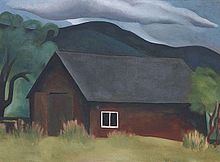
Mental wellness [edit]
O'Keeffe'south mental health was fragile. In 1928, Stieglitz began a long-term affair with Dorothy Norman, who was too married, and O'Keeffe lost a projection to create a mural for Radio Urban center Music Hall. She was hospitalized for low.[29] At the suggestion of Maria Chabot and Mabel Contrivance Luhan, O'Keeffe began to spend the summers painting in New Mexico in 1929.[47] She traveled by train with her friend the painter Rebecca Strand, Paul Strand's wife, to Taos, where they lived with their patron who provided them with studios.[fifty]
Hospitalization [edit]
In 1933, O'Keeffe was hospitalized for two months later on suffering a nervous breakdown, largely due to Stieglitz's affair with Dorothy Norman.[85] She did not paint once again until January 1934. In 1933 and 1934, O'Keeffe recuperated in Bermuda and returned to New United mexican states in 1934. In Baronial 1934, she moved to Ghost Ranch, due north of Abiquiú. In 1940, she moved into a house on the ranch holding. The varicolored cliffs surrounding the ranch inspired some of her most famous landscapes.[54] Amongst guests to visit her at the ranch over the years were Charles and Anne Lindbergh, singer-songwriter Joni Mitchell, poet Allen Ginsberg, and photographer Ansel Adams.[86] She traveled and camped at "Black Place" oft with her friend, Maria Chabot, and afterward with Eliot Porter.[54] [64]
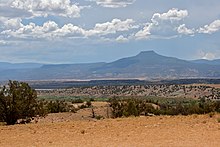
Cerro Pedernal, viewed from Ghost Ranch. This was a favorite field of study for O'Keeffe, who once said, "It'south my private mountain. Information technology belongs to me. God told me if I painted information technology enough, I could have it"[87] [88]

Painting materials equally displayed at the O'Keeffe Museum in Santa Fe, NM
New beginning [edit]
In 1945, O'Keeffe bought a second house, an abandoned hacienda in Abiquiú, which she renovated into a home and studio.[89] Shortly later on O'Keeffe arrived for the summer in New Mexico in 1946, Stieglitz suffered a cerebral thrombosis (stroke). She immediately flew to New York to exist with him. He died on July 13, 1946. She buried his ashes at Lake George.[90] She spent the next 3 years mostly in New York settling his estate,[29] and so moved permanently to New United mexican states in 1949, spending time at both Ghost Ranch and the Abiquiú business firm that she fabricated into her studio.[29] [47]
Todd Webb, a photographer she met in the 1940s, moved to New Mexico in 1961. He often fabricated photographs of her, as did numerous other important American photographers, who consistently presented O'Keeffe as a "loner, a severe figure and self-fabricated person."[91] While O'Keeffe was known to have a "prickly personality," Webb's photographs portray her with a kind of "quietness and calm" suggesting a relaxed friendship, and revealing new contours of O'Keeffe'south grapheme.[92]
Travels [edit]
O'Keeffe enjoyed traveling to Europe, and around the world, beginning in the 1950s. Several times she took rafting trips down the Colorado River,[24] including a trip downwardly the Glen Coulee, Utah, area in 1961 with Webb and photographer Eliot Porter.[54]
Career terminate and death [edit]
In 1973, O'Keeffe hired John Bruce "Juan" Hamilton as a live-in assistant and so a caretaker. Hamilton was a potter, recently divorced and broke. This concluding years companion was 58 years her junior.[93] Hamilton taught O'Keeffe to work with clay, encouraged her to resume painting despite her deteriorating eyesight, and helped her write her autobiography. He worked for her for 13 years.[29] O'Keeffe became increasingly frail in her late 90s. She moved to Santa Fe in 1984, where she died on March 6, 1986, at the age of 98.[94] Her torso was cremated and her ashes were scattered, as she wished, on the land effectually Ghost Ranch.[95]
Estate settlement [edit]
Following O'Keeffe'due south death, her family contested her will because codicils added to information technology in the 1980s had left nigh of her $65 million estate to Hamilton. The case was ultimately settled out of court in July 1987.[95] [96] The instance became a famous precedent in estate planning.[97] [98]
Paintings [edit]
-
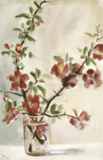
O'Keeffe, Untitled – vase of flowers, 1903–1905, watercolor on paper, Georgia O'Keeffe Museum
-
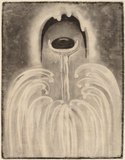
O'Keeffe, Cartoon No. ii – Special, 1915, charcoal on laid paper, 23.6 by 18.two inches (60 cm × 46.3 cm), National Gallery of Art
-
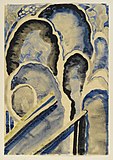
O'Keeffe, Bluish #1, 1916, watercolor and graphite on paper, Brooklyn Museum
-

O'Keeffe, Sunrise, 1916, watercolor on paper
-

O'Keeffe, Serial one, No. 8, 1918, oil-painting on canvas, twenty.0 by 16.0 inches (50.viii cm × forty.vi cm), Lenbachhaus, Munich
-

O'Keeffe, A Storm, 1922, pastel on paper, mounted on analogy lath, eighteen.iii by 24.4 inches (46.four cm × 61.9 cm) Metropolitan Museum of Art
Legacy [edit]
| External video | |
|---|---|
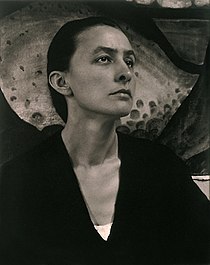 | |
 Life and Artwork of Georgia O'Keeffe, the Georgia O'Keeffe Museum (11:00), C-SPAN[1] Life and Artwork of Georgia O'Keeffe, the Georgia O'Keeffe Museum (11:00), C-SPAN[1] |
O'Keeffe was a legend beginning in the 1920s, known as much for her independent spirit and female person office model as for her dramatic and innovative works of fine art.[95] Nancy and Jules Heller said, "The most remarkable thing about O'Keeffe was the audacity and uniqueness of her early piece of work." At that time, fifty-fifty in Europe, there were few artists exploring abstraction. Even though her works may show elements of different modernist movements, such as Surrealism and Precisionism, her work is uniquely her own style.[99] She received unprecedented acceptance as a woman creative person from the fine art world due to her powerful graphic images and inside a decade of moving to New York Urban center, she was the highest-paid American adult female artist.[100] She was known for a distinctive way in all aspects of her life.[101] O'Keeffe was also known for her human relationship with Stieglitz, in which she provided some insight in her autobiography.[95] The Georgia O'Keeffe Museum says that she was one of the commencement American artists to practice pure abstraction.[2]
Mary Beth Edelson's Some Living American Women Artists / Final Supper (1972) appropriated Leonardo da Vinci's The Last Supper, with the heads of notable women artists collaged over the heads of Christ and his apostles. John the Apostle'southward caput was replaced with Nancy Graves, and Christ's with Georgia O'Keeffe. This image, addressing the role of religious and art historical iconography in the subordination of women, became "one of the most iconic images of the feminist fine art motion."[102] [103]
A substantial part of her estate's assets were transferred to the Georgia O'Keeffe Foundation, a nonprofit. The Georgia O'Keeffe Museum opened in Santa Fe in 1997.[95] The assets included a large body of her piece of work, photographs, archival materials, and her Abiquiú house, library, and belongings. The Georgia O'Keeffe Habitation and Studio in Abiquiú was designated a National Historic Landmark in 1998, and is now endemic by the Georgia O'Keeffe Museum.[89]
In 1996, the U.Southward. Post issued a 32-cent postage stamp honoring O'Keeffe.[104] In 2013, on the 100th anniversary of the Armory Show, the USPS issued a stamp featuring O'Keeffe'due south Blackness Mesa Landscape, New Mexico/Out Back of Marie'southward 2, 1930 equally part of their Mod Fine art in America series.[105]
A fossilized species of archosaur was named Effigia okeeffeae ("O'Keeffe's Ghost") in January 2006, "in honour of Georgia O'Keeffe for her numerous paintings of the badlands at Ghost Ranch and her interest in the Coelophysis Quarry when it was discovered".[106]
In November 2016, the Georgia O'Keeffe Museum recognized the importance of her time in Charlottesville by dedicating an exhibition, using watercolors that she had created over three summers. It was entitled, O'Keeffe at the University of Virginia, 1912–1914.[22]
O'Keeffe holds the tape ($44.four million in 2014) for the highest cost paid for a painting by a adult female.[107]
In 1991, PBS aired the American Playhouse production A Wedlock: Georgia O'Keeffe and Alfred Stieglitz, starring Jane Alexander as O'Keeffe and Christopher Plummer every bit Alfred Stieglitz.[108]
Lifetime Television produced a biopic of Georgia O'Keeffe starring Joan Allen every bit O'Keeffe, Jeremy Irons as Alfred Stieglitz, Henry Simmons as Jean Toomer, Ed Begley Jr. every bit Stieglitz's brother Lee, and Tyne Daly equally Mabel Contrivance Luhan. Information technology premiered on September 19, 2009.[109] [110]
Publications [edit]
- O'Keeffe, Georgia (1976). Georgia O'Keeffe. New York: Viking Press. ISBN978-0-670-33710-ane.
- O'Keeffe, Georgia (1988). Some Memories of Drawings. Albuquerque, NM: Academy of New United mexican states Press. ISBN978-0-8263-1113-nine.
- Giboire, Clive, ed. (1990). Lovingly, Georgia: The Complete Correspondence of Georgia O'Keeffe & Anita Pollitzer . New York: Simon & Schuster. ISBN978-0-671-69236-0.
- O'Keeffe, Georgia (1993). Georgia O'Keeffe : American and modern. New Haven: Yale University. ISBN978-0-300-05581-viii.
- Greenough, Sarah, ed. (2011). My Faraway One: Selected Letters of Georgia O'Keeffe and Alfred Stieglitz. Vol. I, 1915–1933 (Annotated ed.). New Oasis, CT: Yale University Press. ISBN978-0-300-16630-9.
- Buhler Lynes, Barbara (2012). Georgia O'Keeffe and Her Houses: Ghost Ranch and Abiquiu. Harry N. Abrams. ISBN978-1-4197-0394-ii.
- Winter, Jeanette (1998). My Name is Georgia: A Portrait. San Diego, New York, London: Showtime Voyager Books. ISBN0-xv-201649-10.
References [edit]
- ^ a b "Life and Artwork of Georgia O'Keeffe". C-SPAN. January nine, 2013. Retrieved March 14, 2013.
- ^ a b c d e f g h i j k l m north o p q r southward t u "Georgia O'Keeffe". Biography Aqueduct. A&E Television set Networks. August 26, 2016. Archived from the original on January 16, 2017. Retrieved Jan 14, 2017.
- ^ "Georgia O'Keeffe | American painter". Encyclopedia Britannica. Archived from the original on September 29, 2019. Retrieved October 11, 2019.
- ^ Christiane, Weidemann (2008). 50 women artists you should know . Larass, Petra., Klier, Melanie. Munich: Prestel. ISBN978-3-7913-3956-six. OCLC 195744889. Archived from the original on Apr 4, 2020. Retrieved March 4, 2020.
- ^ "An unabashedly sensual arroyo to a genteel genre". Newsweek. 110: 74–75. November nine, 1987 – via Readers' Guide Abstracts.
- ^ Avishai, Tamar. "Episode 45: Georgia O'Keeffe'due south Deer'south Skull With Pedernal (1936)". The Solitary Palette (Podcast). Retrieved December 25, 2020.
- ^ Rile, Karen (December ane, 2014). "Georgia O'Keeffe and the $44 Million Jimson Weed". JSTOR Daily . Retrieved March 31, 2022.
- ^ "Birth Record Details". Wisconsin Historical Society. Archived from the original on November seven, 2012. Retrieved July 23, 2009.
- ^ "Birthplace of Georgia O'Keeffe". Dominicus Prairie, WI. Archived from the original on July 29, 2017.
- ^ Wisconsin Legislature. 2013–xiv Wisconsin Statutes 2013–xiv S.84.1021 Georgia O'Keeffe Memorial Highway. Archived September 28, 2015, at the Wayback Car
- ^ a b Roxana Robinson (1989). Georgia O'Keeffe: A Life. University Press of New England. p. 193. ISBN0-87451-906-three.
- ^ a b Nancy Hopkins Reily (2007). Georgia O'keeffe, a Individual Friendship: Walking the Sun Prairie Land. Sunstone Printing. p. 54. ISBN978-0-86534-451-viii.
- ^ a b c d due east f g Roberts, Norma J., ed. (1988), The American Collections, Columbus Museum of Fine art, p. 76, ISBN0-8109-1811-0
- ^ Canterbury, Sue (2018). Ida O'Keeffe: Escaping Georgia'south Shadow. Dallas, Texas: Dallas Museum of Art. p. 15. ISBN978-0-300-21456-seven.
- ^ "Colonial Williamsburg Research & Education". www.colonialwilliamsburg.org. Archived from the original on Apr 9, 2020. Retrieved April 9, 2020.
- ^ "Blogger". accounts.google.com.
- ^ Gerry Souter (2017). Georgia O'Keeffe. Parkstone International. pp. 34–35. ISBN978-five-457-46766-8.
- ^ The netherlands Cotter (Jan 5, 2017). "World War I – The Quick. The Expressionless. The Artists". The New York Times. Archived from the original on January 11, 2017. Retrieved January 16, 2017.
- ^ Roxana Robinson; Georgia O'Keeffe (1989). Georgia O'Keeffe: A Life. Academy Printing of New England. pp. 191–193. ISBN978-0-87451-906-viii.
- ^ Kathaleen Roberts (Nov xx, 2016). "Never-before-exhibited O'Keeffe paintings show shift to brainchild". Albuquerque Periodical. Archived from the original on January 16, 2017. Retrieved Jan fourteen, 2017.
- ^ a b c d e Amon Carter Museum of Western Art; Patricia A. Junker; Will Gillham (2001). An American Drove: Works from the Amon Carter Museum. Hudson Hills. p. 184. ISBN978-1-55595-198-6.
- ^ a b "How UVA shaped Georgia O'Keeffe". University of Virginia. November ten, 2016. Archived from the original on Jan 16, 2017. Retrieved January 14, 2017.
- ^ Zilczer, Judith (1999). "'Lite Coming on the Plains': Georgia O'Keeffe's Sunrise Series". Artibus et Historiae. xx (40): 193–194. doi:10.2307/1483675. JSTOR 1483675.
- ^ a b c d east f Eleanor Tufts; National Museum of Women in the Arts; International Exhibitions Foundation (1987). American women artists, 1830–1930. International Exhibitions Foundation for the National Museum of Women in the Arts. p. 81. ISBN978-0-940979-01-7. Archived from the original on Apr 27, 2017. Retrieved January 20, 2017.
- ^ Zilczer, Judith (1999). "'Calorie-free Coming on the Plains': Georgia O'Keeffe's Sunrise Series". Artibus et Historiae. 20 (twoscore): 191–208. doi:10.2307/1483675. JSTOR 1483675.
- ^ a b Sharyn Rohlfsen Udall (2000). Carr, O'Keeffe, Kahlo: Places of Their Ain . Yale Academy Printing. p. 114. ISBN978-0-300-09186-1.
- ^ Michael Abatemarco (April 29, 2016). "Birth of the abstract: Georgia O'Keeffe in Amarillo". Santa Fe New Mexican. Archived from the original on February 23, 2018. Retrieved Jan 18, 2017.
- ^ a b c d Rathbone, Belinda; Shattuck, Roger; Turner, Elizabeth Hutton; Arrowsmith, Alexandra; West, Thomas (1992). Two Lives, Georgia O'Keeffe & Alfred Stieglitz: A Chat in Paintings and Photographs. HarperCollins. ISBN0-06-016895-1. OCLC 974243303.
- ^ a b c d eastward f thousand h i j Carol Kort; Liz Sonneborn (2002). A to Z of American Women in the Visual Arts. New York: Facts on File. p. 170. ISBN0-8160-4397-iii.
- ^ a b Birmingham Museum of Art (2010). Birmingham Museum of Art: guide to the collection. Alabama: Birmingham Museum of Art. p. 144. ISBN978-1-904832-77-5. Archived from the original on December xviii, 2015. Retrieved Jan 15, 2016.
- ^ "Blue and Green Music". Art Institute of Chicago. Archived from the original on January 12, 2017. Retrieved January xviii, 2017.
- ^ a b Rosenfeld, Paul (October 1922). "The Paintings of Georgia O'Keeffe". Vanity Off-white. pp. 56, 112, 114.
- ^ a b Kristy Puchko (April 21, 2015). "15 Things You Should Know About Georgia O'Keeffe". Mental Floss. Archived from the original on January 31, 2017. Retrieved January 14, 2017.
- ^ Liese Spencer (December 31, 2015). "From Georgia O'Keeffe to State of war and Peace: Unmissable Arts Events in 2016". The Guardian. Archived from the original on January 18, 2017. Retrieved January 13, 2017.
- ^ Laura Cumming (April 7, 2012). "The 10 best blossom paintings – in pictures". The Guardian. Archived from the original on January 18, 2017. Retrieved Jan 13, 2017.
- ^ Barbara Buhler Lynes; Jonathan Weinberg; Georgia O'Keeffe Museum (2011). Shared Intelligence: American Painting and the Photograph. Univ of California Press. p. 92. ISBN978-0-520-26906-4.
- ^ "Sale Results – American Fine art". Sotheby's. Nov twenty, 2014. Archived from the original on September 11, 2016. Retrieved January nineteen, 2017.
- ^ "Jimson Weed/White Flower No. 1, 1932 by Georgia O'Keeffe". www.georgiaokeeffe.net . Retrieved June 10, 2020.
- ^ Nochlin, Linda; Reilly, Maura (2015). "Some Women Realists: Role 1". Women artists: the Linda Nochlin reader. pp. 76–85. ISBN978-0-500-23929-2.
- ^ Tessler, Nira (2015). Flowers and Towers: Politics of Identity in the Art of the American 'New Adult female' . Cambridge Scholars Publishing. ISBN978-1-4438-8623-9.
- ^ "Manhattan Residences of Georgia O'Keeffe and Patricia Highsmith Published". NYC LGBT Historic Sites Project. Archived from the original on December 18, 2019. Retrieved December 18, 2019.
- ^ a b "Georgia O'Keeffe (1887–1986): East River from the Thirtieth Story of the Shelton Hotel, 1928". New Britain Museum of American Art. Archived from the original on June 24, 2016. Retrieved January 17, 2017.
- ^ a b "Important Art by Georgia O'Keeffe: Radiator Building – Nighttime, New York". The Fine art Story. Archived from the original on Jan 18, 2017. Retrieved January 17, 2017.
- ^ "Radiator Building – Night, New York". Crystal Bridges Museum of American Fine art. Archived from the original on October 18, 2016. Retrieved January 17, 2017.
- ^ "Georgia O'Keeffe: New York Street with Moon, 1925". Museo Thyssen-Bornemisz. Archived from the original on Dec 19, 2016. Retrieved January 17, 2017.
- ^ "The Shelton with Sunspots, N.Y., 1926". Art Institute of Chicago. Archived from the original on January xviii, 2017. Retrieved January 17, 2017.
- ^ a b c d e f g h i Robert Torchia (September 29, 2016). "O'Keeffe, Georgia – Biography". National Gallery of Art. Archived from the original on January 18, 2017. Retrieved January fourteen, 2017.
- ^ Hunter Drohojowska-Philp (2005). Full Bloom: The Art and Life of Georgia O'Keeffe. West. W. Norton. p. 282. ISBN978-0-393-32741-0.
- ^ Vivien Light-green Fryd (2003). Art and the Crunch of Marriage: Edward Hopper and Georgia O'Keeffe. University of Chicago Printing. p. 164. ISBN978-0-226-26654-1.
- ^ a b c Maurer, Rachel. "The D. H. Lawrence Ranch". University of New Mexico. Archived from the original on June 25, 2009. Retrieved September fifteen, 2009.
- ^ Richmond-Moll, Jeffrey. "Georgia O'Keeffe, Black Cross with Stars and Bluish" (PDF). Archived (PDF) from the original on August 12, 2019.
- ^ "The Lawrence Tree". Wadsworth Archives. Hartford, Connecticut. Archived from the original on February 18, 2017. Retrieved January 18, 2017.
- ^ Eleanor Tufts; National Museum of Women in the Arts; International Exhibitions Foundation (1987). American women artists, 1830–1930. International Exhibitions Foundation for the National Museum of Women in the Arts. p. 83. ISBN978-0-940979-01-7. Archived from the original on February 14, 2017. Retrieved January 20, 2017.
- ^ a b c d e f g "Rotating O'Keeffe exhibit". Fort Worth, Texas: National Cowgirl Museum and Hall of Fame. 2010. Archived from the original on October 14, 2012.
- ^ a b c "Summertime Days". Georgia O'Keeffe Museum. Archived from the original on February eight, 2017. Retrieved January 18, 2017.
- ^ "Summer Days". Whitney Museum of American Art. Archived from the original on February ii, 2017. Retrieved January 18, 2017.
- ^ Saville, Jennifer (1990), Georgia O'Keeffe: Paintings of Hawai'i, Honolulu: Honolulu Academy of Arts, p. xiii
- ^ Jennings, Patricia & Maria Ausherman, Georgia O'Keeffe's Hawai'i, Koa Books, Kihei, Hawaii, 2011, p. 3
- ^ Papanikolas, Theresa, Georgia O'Keeffe and Ansel Adams, The Hawai'I Pictures, Honolulu Museum of Fine art, 2013
- ^ Severson, Don R. (2002), Finding Paradise: Isle Art in Individual Collections, University of Hawaii Printing, p. 119
- ^ a b Tony Perrottet (November 30, 2012), O'Keeffe'due south Hawaii Archived Dec 2, 2012, at the Wayback Machine New York Times.
- ^ "Georgia O'Keeffe Paints Hawaii". National Endowment for the Humanities (NEH). Archived from the original on February 5, 2020. Retrieved April nine, 2020.
- ^ Severson, Don R. (2002), Finding Paradise: Isle Art in Private Collections, Academy of Hawaii Press, p. 128
- ^ a b Porter'south photograph, Eroded Clay and Rock Flakes, Black Place, New Mexico, July 20, 1953, on cartermuseum.org, in the Amon Carter Museum Eliot Porter Drove Archived August nineteen, 2016, at the Wayback Machine Retrieved June 16, 2010
- ^ "The White Identify in Sun, 1943". Art Establish of Chicago. Archived from the original on February one, 2017. Retrieved January xviii, 2017.
- ^ Nancy Hopkins Reily (2009). Georgia O'Keeffe, a Private Friendship: Walking the Abiquiu and Ghost Ranch land. Sunstone Press. pp. 152–153. ISBN978-0-86534-452-5. Archived from the original on February 14, 2017. Retrieved January 20, 2017.
- ^ Nancy Hopkins Reily (2009). Georgia O'Keeffe, a Private Friendship: Walking the Abiquiu and Ghost Ranch land. Sunstone Press. p. 325. ISBN978-0-86534-452-v. Archived from the original on February 14, 2017. Retrieved January 20, 2017.
- ^ a b "Biography". Georgia O'Keeffe Museum. Archived from the original on November 15, 2012. Retrieved February 27, 2011.
- ^ Jack Salzman (1990). American Studies: An Annotated Bibliography 1984–1988. Cambridge University Press. p. 112. ISBN978-0-521-36559-8. Archived from the original on February xiv, 2017. Retrieved January twenty, 2017.
- ^ Georgia O'Keeffe Identify Setting, Brooklyn Museum, archived from the original on June 20, 2015, retrieved June 5, 2015 .
- ^ "Georgia O'Keeffe". Brooklyn Museum. Archived from the original on January 21, 2017. Retrieved January xviii, 2017.
- ^ "Georgia O'Keeffe at Tate Modern Review". Design Curial. October 10, 2016. Archived from the original on February 2, 2017. Retrieved January 18, 2017.
- ^ "Georgia O'Keeffe". Educational activity, Smithsonian American Art Museum. Archived from the original on June 29, 2012. Retrieved January 20, 2017.
- ^ "The Flowers and Basic of Georgia O'Keeffe: A Research-Based Dissertation Culminating in a Full-Length Play: Days with Juan - ProQuest". www.proquest.com . Retrieved March 31, 2022.
- ^ a b c Mitchell, Marilyn Hall (1978). "Sexist Art Criticism: Georgia O'Keeffe: A Example Study". Signs. 3 (3): 681–687. ISSN 0097-9740.
- ^ "Sex, Stieglitz and Georgia O'Keeffe | art | Agenda | Phaidon". www.phaidon.com . Retrieved March 31, 2022.
- ^ "Georgia O'Keeffe: Inevitable Icon - ProQuest". www.proquest.com . Retrieved March 31, 2022.
- ^ "Special Collections Enquiry Eye Knowledgebase".
- ^ "Book of Members, 1780–2010: Chapter O" (PDF). American Academy of Arts and Sciences. Archived (PDF) from the original on June thirteen, 2011. Retrieved April xiv, 2011.
- ^ The National First Ladies Library (2010). Heroes of the Presidential Medal of Freedom (PDF). County Ohio. p. 3. Archived (PDF) from the original on February 14, 2011. Retrieved February xi, 2011.
Georgia O'Keeffe (1887–1986)...Presidential Medal of Liberty received January ten, 1977
- ^ John F. Matthews (June 15, 2010). "O'Keeffe, Georgia Otto". Handbook of Texas Online. Archived from the original on December 31, 2015. Retrieved Jan 17, 2016.
- ^ Brennan, Marcia (2002). Painting Gender, Constructing Theory: The Alfred Stieglitz Circle and American Formalist Aesthetics . MIT Press. ISBN0-262-52336-1.
- ^ Lynes, Barbara (1989). O'Keeffe, Stieglitz and the Critics, 1916–1929. Ann Arbor, Michigan: UMI Research Press. pp. 55–56. ISBN0-8357-1930-8.
- ^ McKenna, Kristine (June 2, 1991). "The Young and the Restless : O'Keefe & Stieglitz: An American Romance, By Benita Eisler (Doubleday: 560 pp.)". Los Angeles Times. ISSN 0458-3035. Archived from the original on April xvi, 2017. Retrieved Apr fifteen, 2017.
- ^ Hunter Drohojowska-Philp (2005). Full Bloom: The Fine art and Life of Georgia O'Keeffe. W. W. Norton. pp. 5–6. ISBN978-0-393-32741-0. Archived from the original on February 14, 2017. Retrieved January twenty, 2017.
- ^ Jonathan Stewart (2014). Walking Away From The State: Change At The Crest Of A Continent. Xlibris Corporation. p. 319. ISBN978-1-4931-8090-5. Archived from the original on February fourteen, 2017. Retrieved January xx, 2017. [ cocky-published source ]
- ^ Abrams, Dennis. O'Keeffe, Georgia. 2009. Georgia O'Keeffe. Infobase Publishing, p. 97
- ^ A similar remark is registered in "Her Story and Her Piece of work" Archived October 29, 2011, at the Wayback Machine by Bill Long, six/29/07.: "I painted it often enough thinking that, if I did so, God would give it to me."
- ^ a b Victor J. Danilov (2013). Famous Americans: A Directory of Museums, Historic Sites, and Memorials. Scarecrow Press. p. 17. ISBN978-0-8108-9186-9. Archived from the original on February 14, 2017. Retrieved Jan 20, 2017.
- ^ Dennis Abrams; Georgia O'Keeffe (2009). Georgia O'Keeffe. Infobase Publishing. p. 100. ISBN978-ane-4381-2827-six. Archived from the original on February 14, 2017. Retrieved January 20, 2017.
- ^ Kilian, Michael (Baronial 1, 2002). "Santa Fe showroom paints a different picture of O'Keeffe". Chicago Tribune. Archived from the original on December four, 2010. Retrieved October 10, 2010.
... her place, through the eyes and lens of her close and longtime friend, lensman Todd Webb (1905–2000), who produced a glorious collection of photos of her and her surround at her Ghost Ranch and Abiquiú houses betwixt 1955 and 1981.
- ^ Zimmer, William (December 31, 2000). "Art; Exploring the Affinities Amid Painting, Music and Dance". The New York Times. Archived from the original on June 21, 2018. Retrieved October x, 2010.
O'Keeffe'southward prickly personality is legendary, merely with Webb she displays the kind of quietness and calm she wanted to embody.
- ^ "Who Was Georgia O'Keeffe's Younger Human, Juan Hamilton?". Artdex. Jan 26, 2021. Retrieved September 16, 2021.
- ^ Asbury, Edith Evans (March 7, 1986). "Obituary: Georgia O' Keeffe Expressionless at 98; Shaper of Modern Art in U.S." The New York Times. Archived from the original on September 29, 2009. Retrieved June thirteen, 2010.
- ^ a b c d e Ballad Kort; Liz Sonneborn (2002). A to Z of American Women in the Visual Arts. New York: Facts on File. p. 171. ISBN0-8160-4397-three.
- ^ "Settlement Is Granted Over O'Keeffe Estate". The New York Times. Associated Printing. July 26, 1987. Archived from the original on February 15, 2009. Retrieved June 1, 2010.
- ^ Anne Dingus. "Georgia O'Keeffe". Texas Monthly. Archived from the original on September 6, 2007. Retrieved January 3, 2007.
- ^ Vaughn W. Henry (May 10, 2004). "Establishing a Value is Important!". Planned Giving Design Eye, LLC. Archived from the original on Feb xiii, 2007. Retrieved Jan 3, 2007.
- ^ Jules Heller; Nancy Heller (1995). North American Women Artists of the Twentieth Century: A Biographical Dictionary . Garland. p. 416. ISBN978-0-8240-6049-seven. Archived from the original on December 16, 2019. Retrieved March half dozen, 2020.
- ^ Hunter Drohojowska-Philp (2005). Total Blossom: The Art and Life of Georgia O'Keeffe. W.West. Norton. pp. 4–v. ISBN978-0-393-32741-0. Archived from the original on February 14, 2017. Retrieved January twenty, 2017.
- ^ Alexandra Lange (June 23, 2017). "Jane Jacobs, Georgia O'Keeffe, and the Power of the Marimekko Dress". The New Yorker. Archived from the original on June 29, 2018. Retrieved July 25, 2018.
- ^ "Mary Beth Edelson". The Frost Art Museum Drawing Project. Archived from the original on January 11, 2014. Retrieved January 11, 2014.
- ^ "Mary Beth Adelson". Clara – Database of Women Artists. Washington, D.C.: National Museum of Women in the Arts. Archived from the original on January 10, 2014. Retrieved January 10, 2014.
- ^ "Stamp Serial". United States Postal service. Archived from the original on August ten, 2013. Retrieved September ii, 2013.
- ^ "Mod Art in America 1913–1931, Forever". USPS. Archived from the original on March 16, 2015. Retrieved March viii, 2015.
- ^ Sterling J Nesbitt1, and Marker A Norell (May 7, 2006). "Extreme convergence in the torso plans of an early suchian (Archosauria) and ornithomimid dinosaurs (Theropoda)". Proc Biol Sci. The Royal Society. 273 (1590): 1045–1048. doi:ten.1098/rspb.2005.3426. PMC1560254. PMID 16600879.
- ^ "The Most Expensive Female Artists 2016 – artnet News". artnet News. May 24, 2016. Archived from the original on November 17, 2017. Retrieved November 17, 2017.
- ^ Susan Rex (July 14, 1991). "Focus : Georgia on Her Heed : Jane Alexander'due south Fascination With Artist O'Keeffe Leads to PBS' 'Playhouse'". Los Angeles Times. Archived from the original on Feb ane, 2017. Retrieved January eighteen, 2017.
- ^ "Georgia O'Keeffe". Lifetime Tv'south. Archived from the original on August thirty, 2009.
- ^ Vincent Terrace (2010). The Year in Television, 2009: A Catalog of New and Continuing Series, Miniseries, Specials and TV Movies. McFarland. p. 59. ISBN978-0-7864-5644-4. Archived from the original on February xiv, 2017. Retrieved January 20, 2017.
Further reading [edit]
- Eldredge, Charles C. (1991). Georgia O'Keeffe . New York: Harry N. Abrams, Inc. ISBN978-0-8109-3657-7.
- Haskell, Barbara, ed. (2009). Georgia O'Keeffe: Abstraction. Whitney Museum of American Art. New Oasis, CT: Yale Academy Press. ISBN978-0-300-14817-half dozen.
- Hogrefe, Jeffrey (1994). O'Keeffe, The Life of an American Legend. New York: Bantam. ISBN978-0-553-56545-4.
- Lisle, Laurie (1986). Portrait of an Artist. New York: Washington Square Press. ISBN978-0-671-60040-2.
- Lynes, Barbara Buhler (1999). Georgia O'Keeffe: Catalogue Raisonné. Washington, D.C.: National Gallery of Art. ISBN978-0-300-08176-3.
- Lynes, Barbara Buhler; Poling-Kempes, Lesley; Turner, Frederick W. (2004). Georgia O'Keeffe and New Mexico: A Sense of Place (3rd ed.). Princeton, NJ: Princeton University Press. ISBN978-0-691-11659-iv.
- Lynes, Barbara Buhler (2007). Georgia O'Keeffe Museum Collections. Harry N. Abrams. ISBN978-0-8109-0957-1.
- Lynes, Barbara Buhler; Phillips, Sandra S. (2008). Georgia O'Keeffe and Ansel Adams: Natural Affinities. Little, Brown and Company. ISBN978-0-316-11832-3.
- Lynes, Barbara Buhler; Weinberg, Jonathan, eds. (2011). Shared Intelligence: American Painting and The Photograph. University of California Press. ISBN978-0-520-26906-4.
- Lynes, Barbara Buhler (2012). Georgia O'Keeffe: Life & Work. Skira. ISBN978-88-572-1232-vi.
- Merrill, C. S. (2010). Weekends with O'Keeffe. Albuquerque, NM: University of New Mexico Press. ISBN978-0-8263-4928-vi.
- Messinger, Lisa Mintz (2001). Georgia O'Keeffe. London: Thames & Hudson. ISBN0-500-20340-7.
- Montgomery, Elizabeth (1993). Georgia O'Keeffe. New York: Barnes & Noble. ISBN978-0-88029-951-0.
- Orford, Emily-Jane Hills (2008). The Creative Spirit: Stories of 20th Century Artists. Ottawa: Baico Publishing. ISBN978-ane-897449-18-9.
- Patten, Christine Taylor; Cardona-Hine, Alvaro (1992). Miss O'Keeffe. Albuquerque, NM: Academy of New Mexico Printing. ISBN978-0-8263-1322-5.
- Peters, Sarah W. (1991). Becoming O'Keeffe. New York: Abbeville Press. ISBN978-1-55859-362-6.
External links [edit]
- Georgia O'Keeffe Museum Collections Online
- Georgia O'Keeffe at the Museum of Mod Fine art
- Alfred Stieglitz/Georgia O'Keeffe Archive at the Beinecke Rare Volume and Manuscript Library at Yale Academy
- "O'Keeffe!", a solo player play by Lucinda McDermott, Playscripts, Inc.
- Works past or well-nigh Georgia O'Keeffe in libraries (WorldCat catalog)
- Works past Georgia O'Keeffe at Open Library
- Georgia O'Keeffe, Archives of American Fine art, Smithsonian Establishment
Source: https://en.wikipedia.org/wiki/Georgia_O%27Keeffe
0 Response to "How Common Is the Art of Georgia O Keefe?"
Post a Comment